Our premium 5-stage whole house water filtration system delivers clean, great-tasting water from every tap in your home. With advanced multi-stage filtration and salt-free scale prevention, it protects your family and your appliances — without maintenance headaches, salt refills, or water waste.
Los Angeles tap water presents a unique combination of challenges: chloramines instead of simple chlorine, very hard water (200–400 mg/L), sediment from aging distribution infrastructure, and disinfection byproducts that standard single-stage filters cannot address. Our 5-stage system is specifically configured to handle all of it.
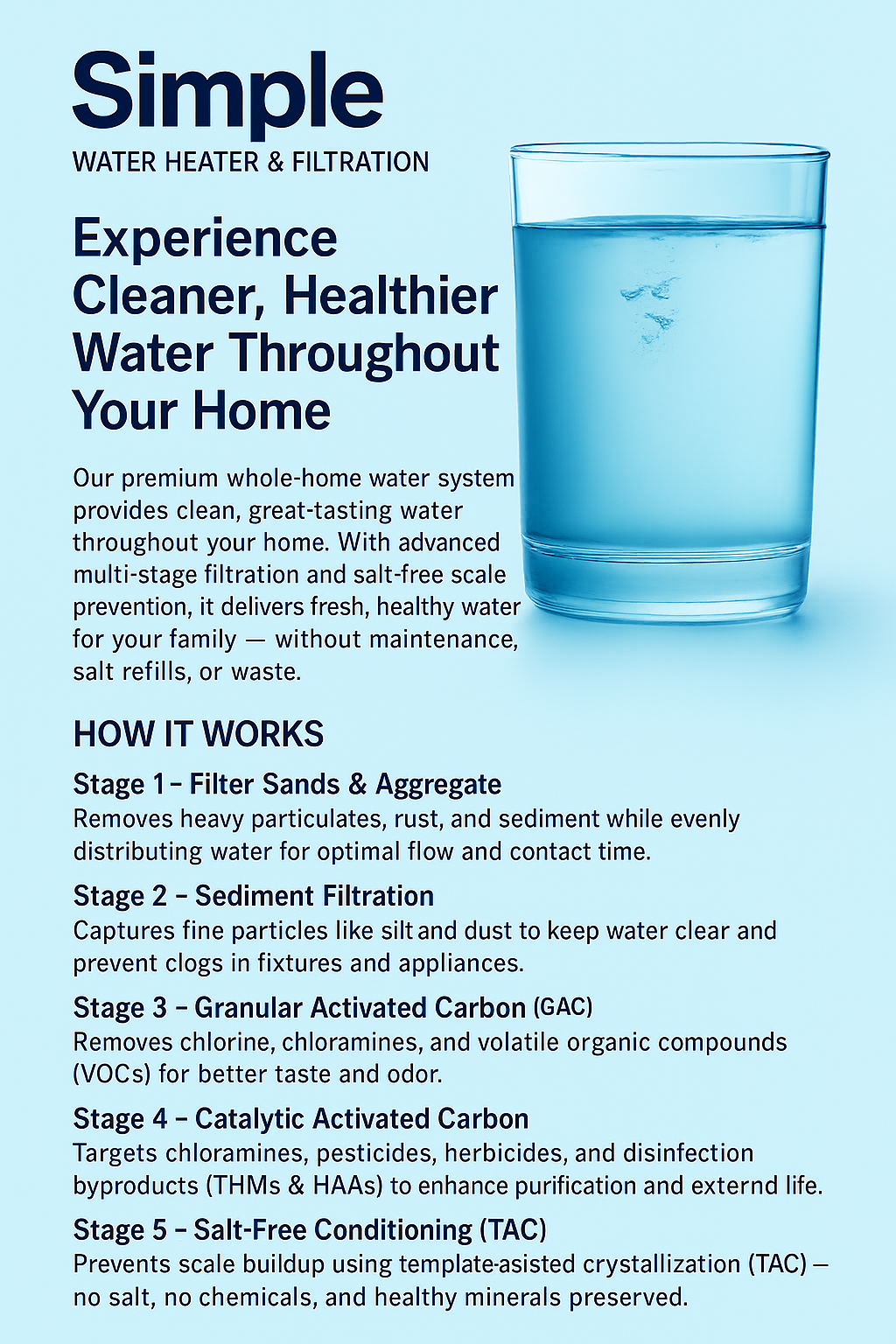
Upload img/whole-house-filtration-5stage.png to display brochure image
LADWP water is safe to drink by EPA standards — but "safe" and "clean" are not the same thing. Here is what our 5-stage system addresses:
LADWP uses chloramines (chlorine + ammonia) to disinfect water. They affect taste, odor, and can irritate skin and eyes. Standard carbon filters do not remove them effectively — catalytic carbon is required.
LA's water is very hard — 3 to 6 times the soft water threshold. Calcium and magnesium deposit as scale on pipes, appliances, showerheads, and inside water heaters, reducing efficiency and lifespan.
When chloramines react with organic matter in the water supply, they form trihalomethanes (THMs) and haloacetic acids (HAAs) — disinfection byproducts that accumulate over time with regular consumption.
LA's aging water infrastructure introduces sediment, rust particles, and fine silt into the supply. These particles clog fixtures, damage appliance components, and affect water clarity.
Volatile organic compounds, pesticides, and herbicides enter the water supply from agricultural runoff and urban sources. LA's blend of Colorado River water and local groundwater sources can carry these contaminants.
The chloramine smell and metallic taste of LA tap water is a common complaint. Most LA residents who have whole house filtration installed report an immediate and significant improvement in the taste and odor of their water.
Each stage targets a specific set of contaminants. Together they provide comprehensive protection that no single-stage filter can match.
The first stage uses a bed of filter sand and aggregate media to capture heavy particulates, rust flakes, and coarse sediment before they reach the finer filtration stages. This layer also distributes water flow evenly across the filter bed, ensuring optimal contact time with the media in subsequent stages. In Los Angeles, where aging distribution pipes shed rust and sediment, this first stage protects everything downstream.
The second stage uses fine sediment filtration media to capture silt, fine particles, and micro-particulates that pass through the first stage. This keeps water visually clear and prevents fine particles from clogging fixtures, valve seats, and appliance components. Clear water entering your water heater, dishwasher, and washing machine significantly extends their operational life.
Granular activated carbon is one of the most effective filtration media available for water treatment. The massive surface area of activated carbon — up to 1,000 square meters per gram — adsorbs chlorine, many chloramines, and volatile organic compounds (VOCs) as water passes through. This is the stage primarily responsible for the immediate improvement in taste and odor that most customers notice right after installation. It also reduces many pesticides and herbicides that enter the water supply from agricultural and urban sources.
This is the stage that makes our system particularly suited to Los Angeles water. Catalytic activated carbon is a specially processed form of carbon that is significantly more effective than standard GAC at removing chloramines — the disinfectant LADWP uses rather than simple chlorine. It also targets pesticides, herbicides, and critically, disinfection byproducts including trihalomethanes (THMs) and haloacetic acids (HAAs). These byproducts form when chloramines react with organic matter in the water supply and have been the subject of ongoing regulatory attention. Stage 4 also extends the operational life of Stage 3 by handling the compounds that would otherwise exhaust the GAC media faster.
The fifth and final stage addresses Los Angeles's most pervasive water quality problem: hard water scale. Template Assisted Crystallization (TAC) is a physical water treatment process that converts dissolved calcium and magnesium — the minerals responsible for scale — into microscopic crystals that remain suspended in the water rather than depositing on surfaces. Unlike traditional salt-based water softeners, TAC does not remove the minerals (which many people prefer to keep for health reasons), does not add sodium to the water, requires no regeneration cycles, produces zero water waste, and needs virtually no maintenance. The result is water that flows through your pipes, water heater, and appliances without leaving scale deposits — backed by independent testing at Arizona State University showing 96–99% reduction in scale formation.
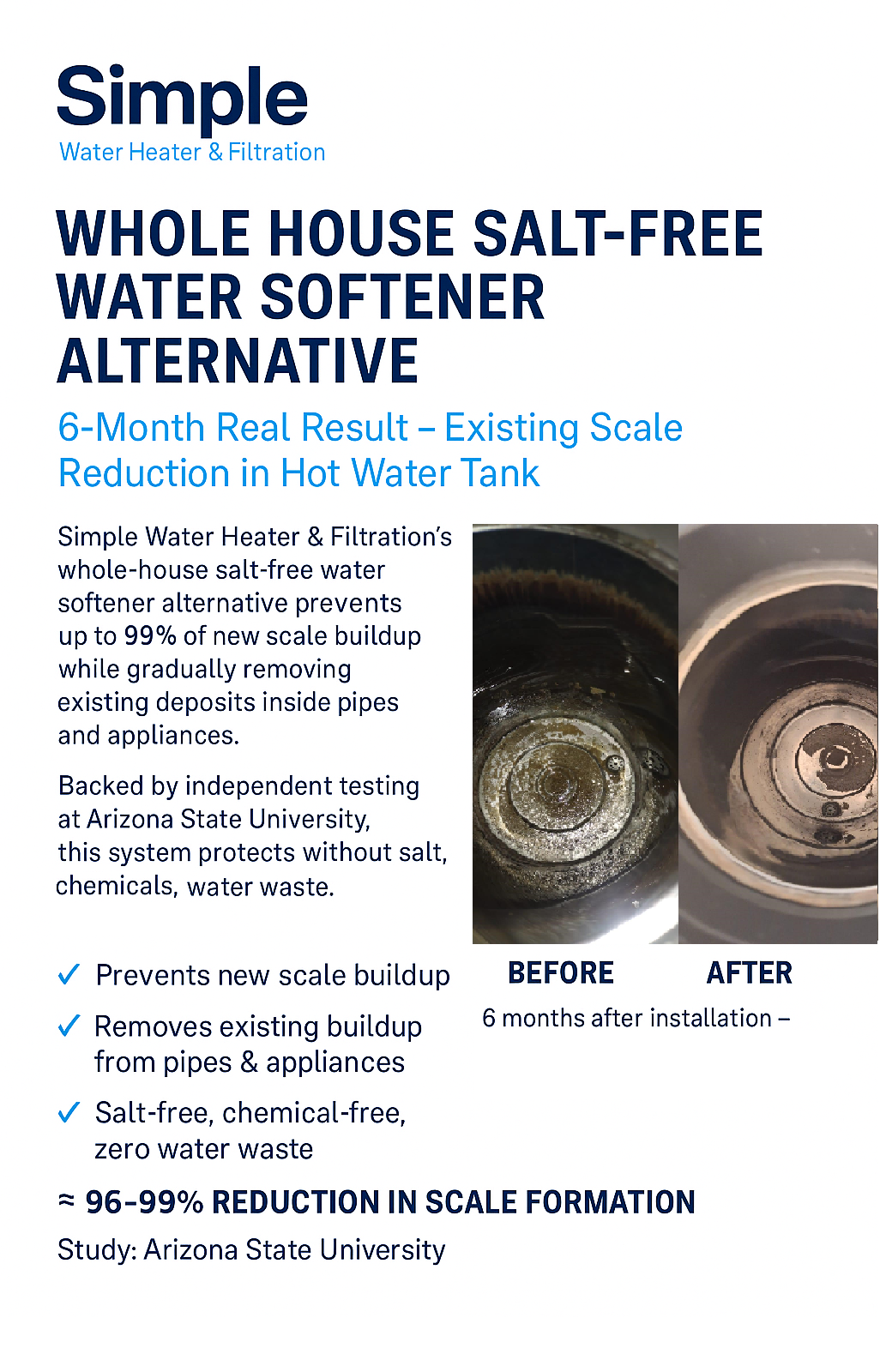
The before and after images from one of our Los Angeles installations tell the story clearly. Six months after installing our 5-stage system with TAC conditioning, the scale accumulation inside the hot water tank was dramatically reduced — and this reduction continues over time as the system gradually works on existing deposits while preventing any new ones.
Reduction in scale formation
Study: Arizona State University — independent testing of TAC technology on hard water scale prevention.
Upload img/scale-before-after.png to display before/after photo
Heavy scale accumulation
6 months after installation
The chloramine smell and metallic taste most LA residents associate with tap water disappears. Most customers report they prefer their filtered tap water to bottled water within the first week.
Chloramine removal means softer-feeling water on skin and hair. Many customers with sensitive skin or color-treated hair notice an improvement immediately. Showerheads stay cleaner longer with reduced scale.
The white spots on glassware from the dishwasher — caused by hard water scale — are significantly reduced or eliminated. Dishes come out clearer and dry faster without water marks.
Scale buildup is the primary cause of premature water heater failure in Los Angeles. TAC conditioning upstream of your water heater prevents heat exchanger scale on tankless units and sediment accumulation in tank units — significantly extending lifespan.
Your dishwasher, washing machine, coffee maker, and ice maker all benefit from scale-free water. The heating elements and internal components of these appliances last longer without mineral deposits restricting flow and causing overheating.
Unlike traditional water softeners, our system adds nothing to the water and wastes nothing. No salt to refill, no regeneration water discharge, no sodium added to your drinking and cooking water, and no impact on your landscaping.
| Feature | Basic Carbon Filter | Salt Softener Only | Our 5-Stage System |
|---|---|---|---|
| Removes sediment | |||
| Removes chlorine | |||
| Removes chloramines (LA water) | |||
| Removes VOCs & pesticides | Partial | ||
| Removes THMs & HAAs | |||
| Prevents scale buildup | |||
| Salt-free | |||
| Zero water waste | |||
| Preserves healthy minerals | |||
| Improves taste & odor | Partial |
We install our whole house filtration system throughout Los Angeles and surrounding areas:
Not listed? View all service areas — we serve over 60 cities throughout LA and Ventura County.
We assess your home's specific water quality needs and provide upfront pricing before any work begins.
Call (855) 4-HOT-H20 Get an Estimate